Fish Calories: Species, Packing Medium and Coatings Change the Reference
Plain fish, oil-packed canned fish and breaded fish products are different food descriptions. A useful estimate distinguishes the edible species and preparation, the packing liquid actually eaten and any coating. A can's total weight or a fillet's appearance does not provide all that information.
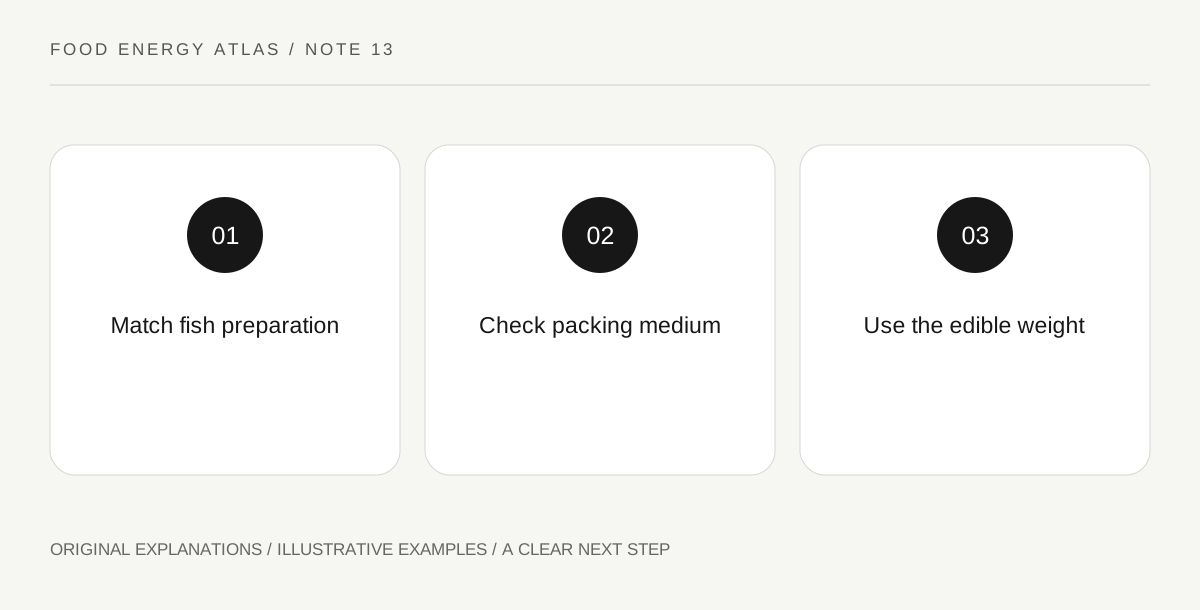
Original explanatory diagram. Read the full method and limitations below.
Match the species and preparation
A generic fish search can return species with different compositions as well as raw, cooked and processed forms. Read the full description and select the closest match. A current label on a packaged fillet or prepared product may be a more relevant source than an unrelated generic fish entry.
Use a cooked reference with a cooked edible portion if following the direct serving method. A raw ingredient estimate is another route, but it should remain identifiable as such. Do not apply a raw concentration to a cooked weight simply because both records refer to fish. Moisture and preparation differences affect what 100g represents.
Read the can's packing and drained basis
Canned fish may be packed in water, brine, oil or a sauce. Some reference descriptions specify drained solids. If you discard the packing liquid and select a drained-solids entry, weigh that edible material rather than assuming the entire net contents are drained fish.
If oil or sauce is eaten, it should not vanish from the calculation. Decide whether the selected reference already includes it or whether a separate ingredient estimate is needed. There is no universal rule that every oil-packed product contributes the same extra amount after draining. The actual product description and serving method determine the most defensible estimate.
Account for bones, skin and coatings
Some canned fish are eaten with soft bones and skin, while other preparations exclude them. Read the edible-material wording rather than automatically removing or including them in every case. The scale weight must correspond to the selected description.
Breaded or battered fish includes a coating, and a fried product may have a defined prepared-food composition. A plain fish entry plus a guessed coating allowance does not become an exact product analysis. Use the current label when available. For a homemade recipe with known ingredients, document the coating and cooking additions separately and state what remains uncertain after preparation.
Keep a mixed seafood dish reconstructable
A fish pasta, fish cake or seafood salad can contain several substantial components. If you prepared it, an ingredient list and measured finished yield provide a clearer estimate than an unrelated generic dish name. If someone else prepared it, acknowledge that proportions and additions are unknown.
Serving the fish separately from sauce or sides can make a component estimate simpler, but tracking is optional and does not need to turn a meal into a disassembly exercise. The point is to understand the reference's limits. Calories alone do not answer questions about allergens, pregnancy-specific fish advice, contaminants or safe storage; those require separate authoritative guidance.
An illustrative calculation
For arithmetic only, suppose a matching drained-fish record gives 140 kcal per 100g and the edible drained amount is 90g. That yields 126 kcal. If a separately measured sauce contributes 30 kcal, the combined estimate is 156 kcal. Entering a hypothetical 130g undrained can weight against the drained reference would describe a different amount. These invented figures are not a statement about tuna, salmon or any particular packing medium.
Practical checks
Optional checkboxes save only in this browser.
Questions that come up
Can every can of tuna use one generic number?
No. Packing medium, draining basis, product formulation and serving weight can differ. Use the exact label or the closest properly described reference, and state any substitution.
Does draining remove a fixed calorie percentage?
This calculator cannot measure what leaves your particular product. A matching drained-solids reference is preferable to subtracting an invented universal percentage from an undrained value.
References and scope
These sources support the factual background. Examples and exercises are original illustrative teaching material. References do not imply endorsement.
- USDA FoodData Central downloadable datasets — The original SR Legacy CSV archive, its final 2018 release and the source of the searchable food records.
- USDA FoodData Central data-type documentation — Differences among historical generic reference data, foundation foods and branded label data.