Meat Calories: Read Cut, Edible Fat and Cooking State Together
A search for beef or chicken can return many reference foods because cut, edible fat, skin and preparation matter. Choose the material you actually weigh, and distinguish a raw ingredient estimate from a cooked serving. The same animal name does not make all entries interchangeable.
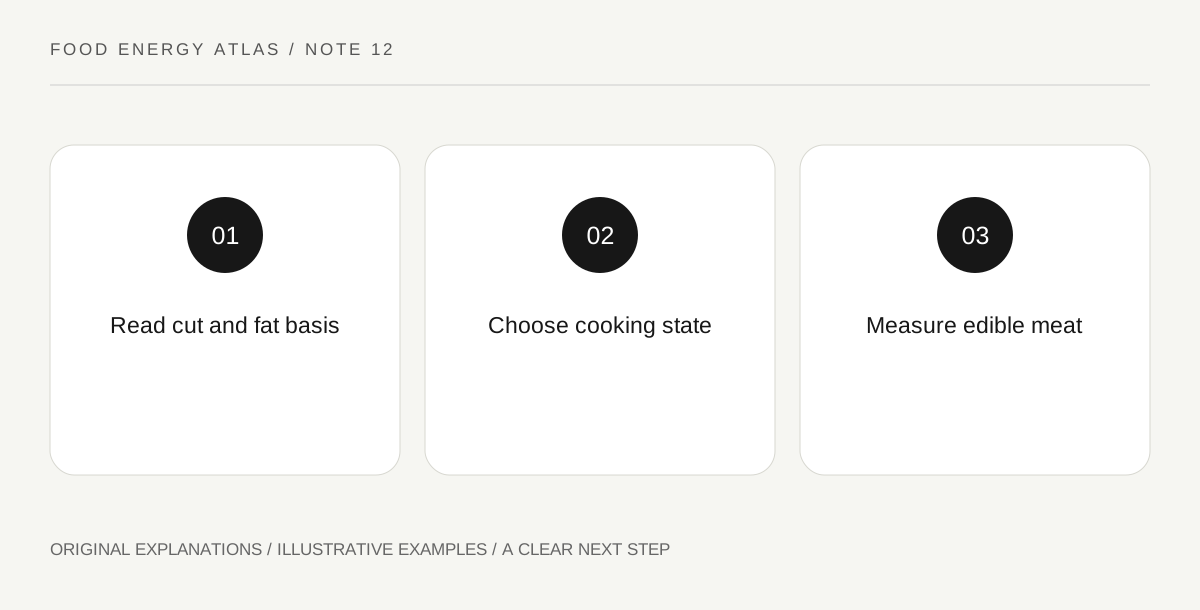
Original explanatory diagram. Read the full method and limitations below.
Use the full cut description
Read whether the reference describes breast, thigh, mince, steak or another cut, and whether it includes skin, lean and fat, or lean only. Those terms identify the edible material. A piece with its visible fat removed should not be assumed identical to a record that includes a different proportion of fat.
For packaged mince or a prepared meat product, current label information can be more specific than a generic historical entry. Do not substitute a preferred lean category just because its number looks lower. The goal is a record that describes the food, not a search result that changes the apparent answer without changing the actual ingredient.
Match raw and cooked weights
Raw ingredient weight and cooked serving weight are different quantities. Cooking can remove moisture and release drippings, changing the concentration per 100g. A cooked portion should use an appropriate cooked reference if following the direct serving-weight method.
For a recipe based on raw ingredients, record that basis and the final batch yield. Do not then count the same meat again as a cooked component. If drippings are discarded, acknowledge the uncertainty in a starting-ingredient total rather than pretending to know exactly how much energy was removed. A kitchen weight does not measure the composition of every discarded liquid.
Separate bones and uneaten parts
A bone-in serving contains material that is not all edible meat. Where practical, weigh the edible portion directly and match skin or fat inclusion to the reference. If using a before-and-after subtraction, explain that bones may retain food or sauce and that the calculation is approximate.
A package's net weight is not automatically the edible meat weight of a meal. Marinade, bones and other components may be included. Check what the weight describes before entering it. The reference's edible basis and the measured material should agree, even if that requires choosing a less convenient but more accurate description.
Treat coatings and sauces as recipe components
Breaded chicken, glazed meat and meat served in a rich sauce are prepared foods with more ingredients than plain cooked meat. Use a matching product label, a clearly relevant prepared entry or a known ingredient calculation. A plain roast reference cannot reveal the coating and sauce amounts.
For a home dish, keep additions on separate lines unless already included in the reference. For a restaurant dish, accept that recipe detail may be unknown. Reporting an estimate with its assumptions is more useful than claiming exact knowledge of fat content or cooking loss. Food-safety cooking requirements are a separate topic; a calorie calculation cannot verify that meat was prepared safely.
An illustrative calculation
Assume an illustrative cooked edible-meat reference gives 190 kcal per 100g. A125g matching cooked portion gives 237.5 kcal. If the scale reading also included a 40g bone, using 165g against that edible-meat value would give 313.5 kcal and misdescribe the measured material. The example uses invented values to demonstrate edible-weight matching; it does not establish a value for a particular cut or predict cooking yield.
Practical checks
Optional checkboxes save only in this browser.
Questions that come up
Can I calculate cooked meat from raw weight alone?
You can make an ingredient-based estimate with stated assumptions, but raw weight alone cannot reveal exact cooking losses or the cooked portion yield. A matching cooked reference and measured cooked weight are another route.
Does trimming visible fat give a known percentage reduction?
Not from this tool. The amount and composition removed are unknown unless appropriately measured and referenced. Do not subtract a universal percentage from every cut.
References and scope
These sources support the factual background. Examples and exercises are original illustrative teaching material. References do not imply endorsement.
- USDA FoodData Central downloadable datasets — The original SR Legacy CSV archive, its final 2018 release and the source of the searchable food records.
- USDA FoodData Central data-type documentation — Differences among historical generic reference data, foundation foods and branded label data.