Milk, Yoghurt and Coffee Additions: Use the Product and the Right Unit
A coffee order and a milk carton do not describe the same reference amount. Dairy foods, plant-based alternatives and sweetened products vary by formulation, while labels may use volume or weight. Keep the actual product, amount and any additions visible instead of assigning one calorie value to every milky drink.
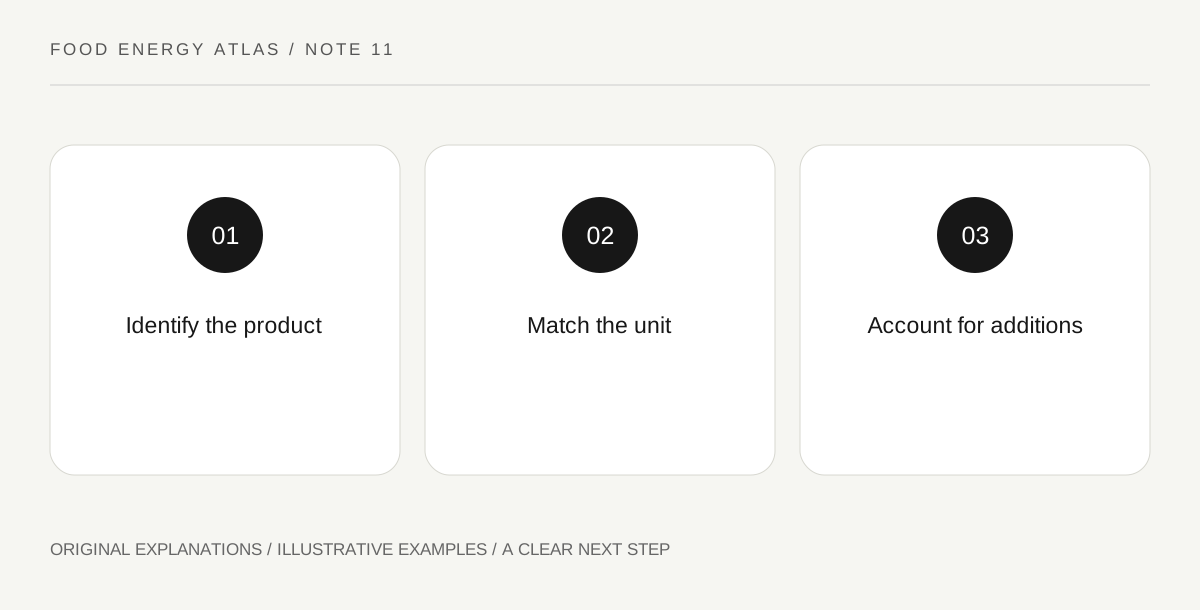
Original explanatory diagram. Read the full method and limitations below.
Distinguish the products before comparing
Whole milk, reduced-fat milk, plain yoghurt, sweetened yoghurt and plant-based drinks have different compositions. Read the exact product description and ingredient information rather than assuming everything called milk or yoghurt shares the same energy value. Historical generic data are a reference, not a substitute for the label on a specific current product.
For a branded drink or flavoured yoghurt, begin with that package when possible. A similar generic product can help with a rough estimate when no label is available, but the substitution should be explicit. Terms such as barista, original or light do not establish a universal recipe across manufacturers.
Keep volume and weight separate
Many drink labels provide a serving in millilitres, while our database scales grams. The label's volume serving can be used directly when you measure volume on the same basis. If working with grams, use a suitable mass-based reference or a product-specific conversion rather than silently treating every millilitre as one gram.
For yoghurt, weighing a portion is often straightforward: tare the bowl and add the product. A spoonful can vary with thickness and how generously it is filled. For a beverage, account for the liquid itself rather than the mug's full weight or the apparent size of foam above the drink.
Reconstruct a home coffee in components
For a home-prepared coffee with known ingredients, note the milk or alternative drink amount and any sugar, syrup, cream or other additions. Use each ingredient's appropriate reference. A black-coffee entry does not describe the additions, and a sweetened prepared-drink entry may already include some of them.
Foam changes the apparent volume in a cup, but does not tell you how much of the original milk was used or left in the jug. Measuring the ingredient used for the actual drink is more informative than assuming all cups of one size contain the same amount. Keep discarded or shared leftovers in mind when dividing a batch.
Use café information within its scope
A café's published nutrition figure usually belongs to a defined size and recipe. A different milk, extra syrup or removed topping can change that recipe. Use the business's current information where available and preserve the selected options in your notes. A menu name alone cannot reveal the full formulation.
When no useful information exists, a component estimate can be labelled rough. Do not present a reconstructed number as a measured café analysis. Calories also do not answer allergy, lactose-tolerance or other suitability questions; those require product information and, where relevant, individual advice. This tool describes an estimated energy amount rather than approving a drink choice.
An illustrative calculation
For an invented milk drink, a label lists 60 kcal per 100ml. A measured 150ml contributes 90 kcal. An added ingredient calculated separately at 20 kcal brings the total to 110 kcal. If a prepared-drink label already included that addition, adding 20 again would double count it. These are illustrative label values, not a claim about all milk, plant-based drinks or café coffees.
Practical checks
Optional checkboxes save only in this browser.
Questions that come up
Can a plant-based drink use dairy milk data?
Use its own label or a closer reference. Different plant ingredients and formulations can produce different values, so the shared use in a coffee does not make the products compositionally equivalent.
Does foam show how much milk was used?
No. Appearance and cup volume do not uniquely determine the mass or volume of original milk in a drink. Ingredient measurement or the café recipe provides a clearer basis.
References and scope
These sources support the factual background. Examples and exercises are original illustrative teaching material. References do not imply endorsement.
- USDA FoodData Central downloadable datasets — The original SR Legacy CSV archive, its final 2018 release and the source of the searchable food records.
- USDA FoodData Central data-type documentation — Differences among historical generic reference data, foundation foods and branded label data.