Bread Calories: A Slice Is a Portion Description, Not a Universal Weight
Two bread slices can differ in thickness, size and ingredients. A per-slice label is useful for that product, while a generic reference often uses 100g. Match the bread and the weight basis before comparing a sandwich, a thick bakery slice or bread that has been toasted.
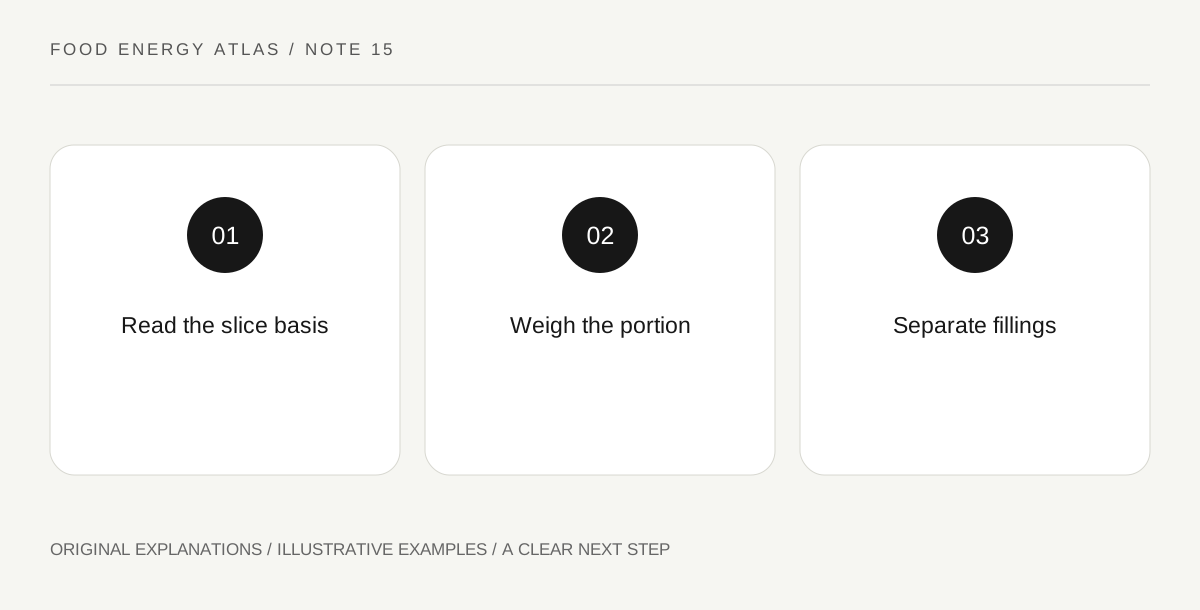
Original explanatory diagram. Read the full method and limitations below.
Use the actual bread product
A current packaged bread label describes its own formulation and stated serving. A generic database entry offers a reference when that label is unavailable, but it may describe a different grain mixture, moisture content or added ingredients. Read the full name instead of selecting any result containing the word bread.
Bakery bread can be especially variable in slice thickness. If a label supplies a two-slice serving with a gram weight, check whether your portion resembles that amount. A large hand-cut slice is not automatically half of any two-slice reference. A simple edible gram measurement can remove that particular ambiguity without pretending to know the exact recipe.
Scale per-slice information coherently
If the label gives calories per slice and you eat a matching slice, that stated amount can be used directly. If weighing a different portion, scale from the label's corresponding gram amount. Do not compare one product's per-slice figure with another's per 100g figure as if they represented equal amounts.
The gram basis also helps with bread rolls, wraps and flatbreads that have different unit sizes. One item can be a very different amount across products. Keep the item description for convenience, but retain its weight or labelled reference so the calculation can be repeated and understood later.
Understand what toasting changes
Toasting can reduce bread's weight by removing moisture. A lighter toasted slice does not imply that the same proportional share of its original food energy disappeared. For a slice already counted from its package, avoid treating its lower toasted weight as a new amount of the untoasted product.
If using a matching toasted-bread reference, follow that reference's prepared-state basis. Choose one route and keep it consistent. The distinction is about the denominator, not a claim that all toasters or bread types have identical yields. Charred or discarded material introduces further uncertainty that a generic calculator cannot measure from appearance.
Keep the sandwich fillings separate
Butter, spreads, cheese and other fillings have their own reference amounts. A bread-only estimate does not describe an assembled sandwich. For a homemade sandwich, list the components. For a prepared packaged sandwich, the complete product label may provide a more relevant estimate than trying to infer its filling quantities.
Do not add fillings again if a prepared sandwich reference already includes them. Similarly, a garlic bread or filled bread product is not plain bread with a name change. A transparent ingredient or product route makes omissions visible and keeps the calculation focused on the food actually eaten rather than an assumed standard sandwich.
An illustrative calculation
An illustrative bread label gives 180 kcal for two slices weighing 70g. A different hand-cut portion of that same bread weighing 50g would be estimated as 180×50÷70, or about 128.6 kcal. If a 70g pair of slices is toasted and becomes 60g, that alone is not evidence its 180 kcal fell in the same proportion. These invented values demonstrate the reference-weight issue rather than describe a particular bread.
Practical checks
Optional checkboxes save only in this browser.
Questions that come up
Does every wrap count as one bread slice?
No. Wraps, rolls and slices have different sizes and formulations. Use a matching product reference and its stated portion, or weigh the edible amount on an appropriate gram basis.
Can a toasted slice use the original label?
For the same original slice without uncounted additions, the original package amount is a coherent ingredient-based estimate. Do not reduce it simply because moisture loss made the slice lighter.
References and scope
These sources support the factual background. Examples and exercises are original illustrative teaching material. References do not imply endorsement.
- USDA FoodData Central downloadable datasets — The original SR Legacy CSV archive, its final 2018 release and the source of the searchable food records.
- USDA FoodData Central data-type documentation — Differences among historical generic reference data, foundation foods and branded label data.