Rice and Pasta Calories: Water Absorption Explains the Weight Change
Dry and cooked rice or pasta can appear far apart in a calorie table because their water content differs. Follow the actual preparation state rather than the lowest number in a search result. Distinguish a dry ingredient, a cooked batch and the portion served from it.
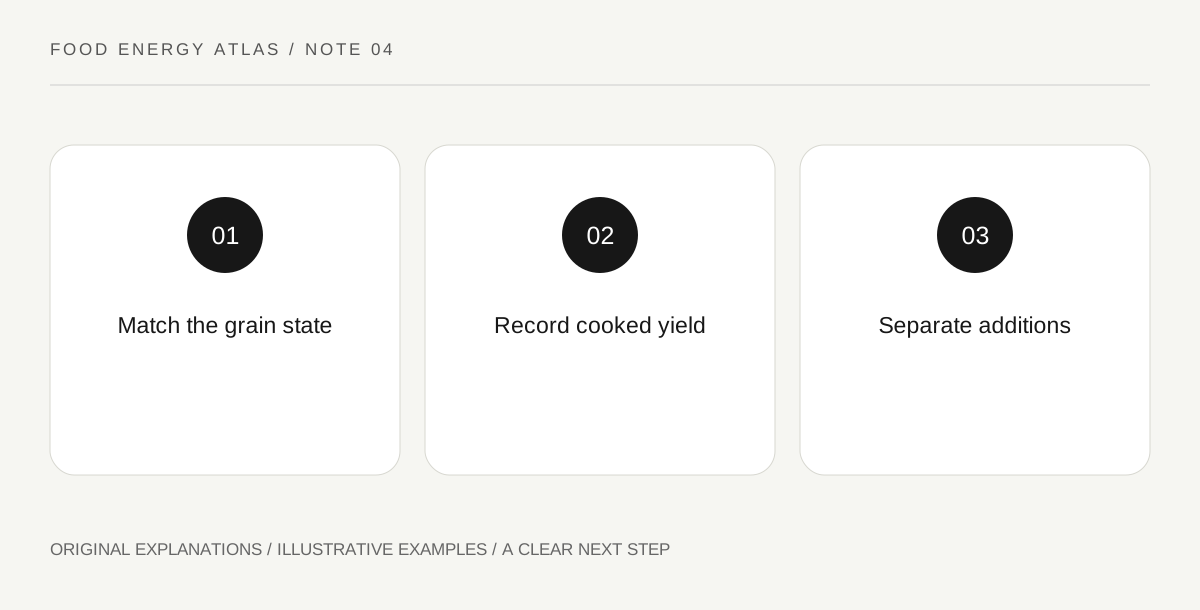
Original explanatory diagram. Read the full method and limitations below.
Search with preparation words
Begin with the food's identity, then add dry or cooked. For rice, the description may specify grain type, enrichment and preparation. For pasta, wheat type, egg content or a gluten-free ingredient blend can matter. A broad word such as noodles may return foods that are not close to what is in your bowl.
Do not choose an unfamiliar reference because its figure looks convenient. Read the full description in the matching-record list and compare it with the package or ingredient you used. When the exact branded product is available, its current label can be a better starting point than a historical generic record with a similar name.
Treat water as a yield change
In a simplified cooking example, dry grain absorbs water and the finished batch becomes heavier. Food energy is now spread over more grams. This explains why a per 100g cooked figure can be lower than a per 100g dry figure even though you have not removed a corresponding share of grain.
Actual cooking can involve drained starch or other losses, so a home calculation remains an estimate. The lesson is not to apply dry-food concentration to cooked-food weight. That mistake can be larger than uncertainty within a matched generic reference. Keep the final drained weight in your notes rather than relying on the pot's total weight with cooking water.
Keep sauces and additions visible
Rice cooked with oil, pasta tossed in pesto and noodles in broth are not identical to plain cooked grains. Decide whether the reference already includes preparation ingredients. If it does not, estimate relevant additions separately. If it does, adding the same oil or sauce again can double count it.
For a mixed pot, a recipe calculation gives a clearer account than a generic dish with an unknown recipe. Record ingredients and total finished weight. A prepared-dish reference remains useful when you did not cook the food, but its recipe uncertainty is larger. The name alone cannot reveal how much oil or cheese a restaurant used.
Divide the batch by weight
If finished food is evenly mixed, estimate a portion's share from its weight divided by final batch weight. Stir before portioning and consider uneven toppings or sauce. Equal-looking bowls need not weigh the same; equal weights can differ if one contains more sauce and another more plain pasta.
Save the batch yield beside the ingredient calculation. A reheated portion may weigh less after losing water, changing per 100g concentration without changing its starting ingredient energy. Avoid repeatedly recalculating a stored portion as if it were an entirely new batch. For leftovers from the original batch, preserve the original portion record and note any later additions separately.
An illustrative calculation
Imagine 80g of dry pasta estimated at 288 kcal and a final plain cooked weight of 200g. A125g portion represents 125÷200 of that batch, or 180 kcal under a simplified no-loss assumption. If sauce added to that portion contributes a separately estimated 40 kcal, the combined estimate is 220 kcal. The sauce is not included in the plain pasta record. These invented quantities demonstrate the method rather than a guaranteed cooking ratio.
Practical checks
Optional checkboxes save only in this browser.
Questions that come up
Does rinsing remove a known percentage of calories?
This tool cannot determine losses from a particular rinsing or cooking method. Do not subtract an invented percentage. Use a suitable cooked reference or label an ingredient-based estimate with its assumptions.
Can one dry-to-cooked ratio always be reused?
A ratio measured from one batch is not universal. Shape, cooking time, grain type and draining affect yield. Reweigh when the method or ingredient changes materially.
References and scope
These sources support the factual background. Examples and exercises are original illustrative teaching material. References do not imply endorsement.
- USDA FoodData Central downloadable datasets — The original SR Legacy CSV archive, its final 2018 release and the source of the searchable food records.
- USDA FoodData Central data-type documentation — Differences among historical generic reference data, foundation foods and branded label data.