Fruit Calories: Fresh, Dried, Juiced and Syrup-Packed Need Separate Comparisons
Fruit names cover very different foods in a reference database. Fresh apple, dried apple and sweetened apple juice cannot share one calorie figure simply because they come from the same fruit. Compare the exact product form, edible weight and any packing liquid before drawing conclusions from the number.
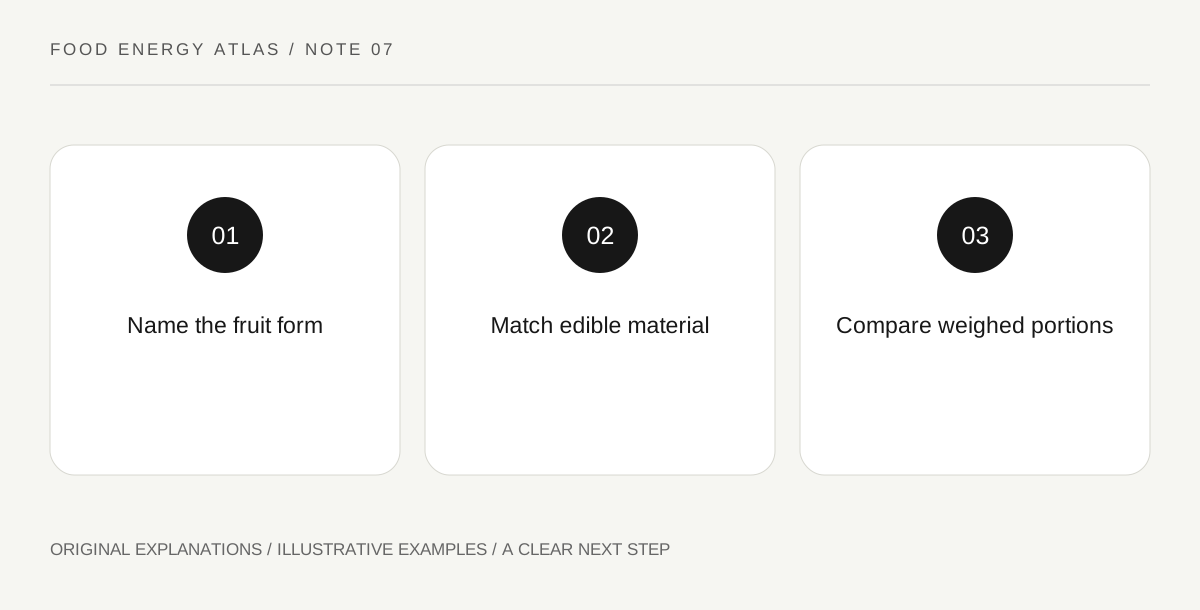
Original explanatory diagram. Read the full method and limitations below.
Start with the fruit form
Use preparation words in the search: raw, dried, juice, canned or frozen, as relevant. Read whether sugar, syrup or other ingredients are included. A frozen unsweetened fruit and a sweetened fruit preparation may sit near each other in search results despite having different formulations.
The same care applies to skin and seeds. A record might describe edible fruit with skin, while your measured portion is peeled. Choose a closer match when available. The database description tells you what the value refers to; a familiar fruit name alone does not establish that two entries describe equivalent edible material.
Compare on a defined basis
A per 100g comparison holds weight constant, but not volume, piece count or the amount of original fruit involved. Dried fruit has a different water content from fresh fruit, so a handful can represent a different amount of fruit material. The reference concentration and the portion are separate parts of the calculation.
For a practical serving comparison, weigh the actual edible portions and calculate each on its own basis. Do not conclude that one form is automatically better from the energy column alone. Texture, convenience, ingredients, other nutrients and individual circumstances can all matter, and this tool does not combine them into a health score.
Be explicit about juice and packing liquid
A juice entry describes a beverage, while a whole-fruit entry describes edible fruit material. Do not convert a glass of juice into grams of whole fruit using the same energy concentration. If a beverage label provides calories per volume, scale that label in the same volume unit or use its specified weight equivalent.
For canned fruit, read whether the reference includes syrup or describes drained solids. If you discard the liquid, a whole-can net weight may not be an edible fruit weight. If you eat the liquid, it should not disappear from the estimate. The correct route depends on the food you actually serve.
Record additions without moral labels
Fruit salads, smoothies and desserts can contain yoghurt, milk, nuts, sugar or other components. Estimate those components separately in a recipe calculation, or use a clearly matching prepared-food entry. A banana reference cannot reveal the entire contents of a smoothie bought elsewhere.
Keep the notes descriptive: peeled banana weight, unsweetened yoghurt amount and any other ingredients. Terms such as clean or guilt-free do not help reconstruct an energy estimate. If food tracking becomes distressing, a reference tool need not be used at every meal; it is an optional educational aid, not a requirement for eating fruit correctly.
An illustrative calculation
Imagine a fresh-fruit portion at an illustrative 50 kcal per 100g and a dried-fruit portion at an illustrative 250 kcal per 100g. A180g fresh portion gives 90 kcal, while a 30g dried portion gives 75 kcal. The lower per 100g figure did not automatically produce the lower portion estimate. These are deliberately invented values: use the actual source descriptions for the fruit forms being compared rather than applying this example to every fruit.
Practical checks
Optional checkboxes save only in this browser.
Questions that come up
Can frozen fruit use a fresh reference?
A plain unsweetened version may be close, but match the available description as carefully as possible. Sweetened frozen products, sauces and blended desserts need their own reference or ingredient calculation.
Does this compare the health value of juice and whole fruit?
No. It estimates energy for a chosen amount. A broader comparison includes fibre, ingredients, how the food is consumed and individual needs, which are not captured by the calorie field alone.
References and scope
These sources support the factual background. Examples and exercises are original illustrative teaching material. References do not imply endorsement.
- USDA FoodData Central downloadable datasets — The original SR Legacy CSV archive, its final 2018 release and the source of the searchable food records.
- USDA FoodData Central data-type documentation — Differences among historical generic reference data, foundation foods and branded label data.