Calories, Kilocalories and the Reference Amount: Read the Whole Number
A calorie figure needs both a unit and an amount of food. Without those two details, a large number on one package and a smaller number in a database cannot be meaningfully compared. Identify what was measured before deciding what the figure says about your own portion.
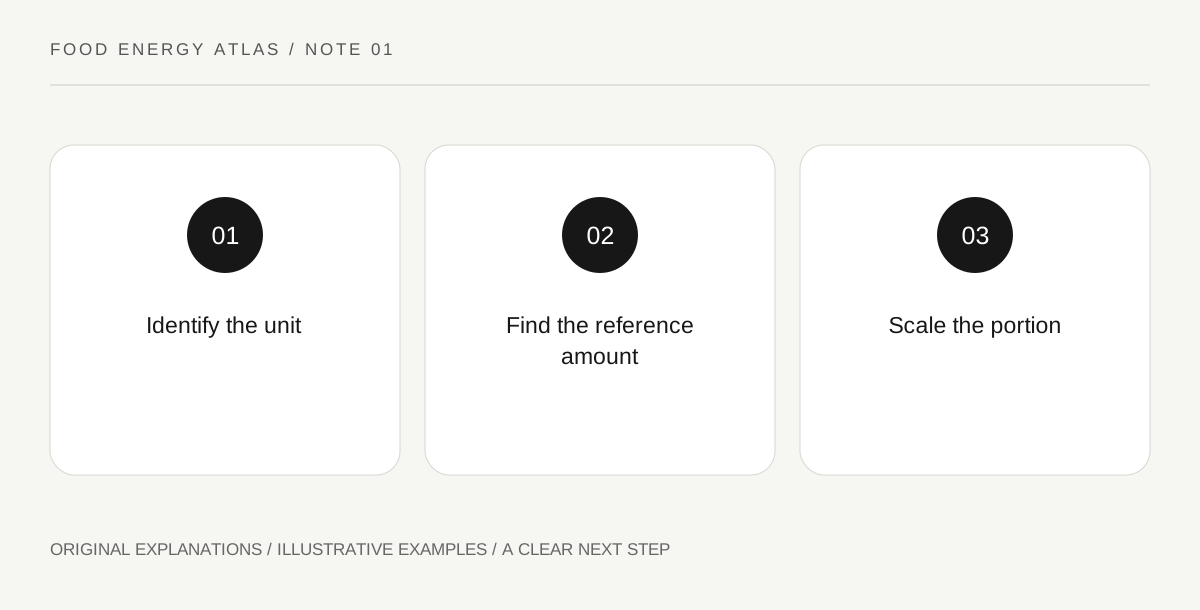
Original explanatory diagram. Read the full method and limitations below.
Connect the unit to the amount
Food energy on many English-language nutrition labels is expressed as Calories, meaning kilocalories, abbreviated kcal. A database value of 120 kcal per 100g describes an energy concentration. It does not say that every bowl, piece or package contains 120 kcal. The reference amount is part of the measurement, just as miles per hour describes a different quantity from miles.
Write the two elements together in your notes: energy value and reference weight. Keeping a bare number such as 120 makes later mistakes easy, especially when moving between a package label that uses a serving and a database that uses 100 grams. The denominator determines how the number can be used.
Use a proportion for the portion
Once the food record matches, scale its value to the edible amount you actually weighed. Multiply kcal per 100g by grams, then divide by 100. The denominator belongs to the source reference, so it stays 100 even when your portion is larger or smaller. You do not need a separate database entry for every possible portion.
For an invented food at 120 kcal per 100g, a 75g portion gives 90 kcal. A150g portion gives 180 kcal. These numbers illustrate proportional arithmetic; they are not measurements of a particular food or suggestions for how much anyone should eat. The food identity and preparation assumptions stay the same in both calculations.
Separate energy from nutritional quality
The energy calculation answers one narrow question. It does not tell you whether a food supplies enough protein, fibre, vitamins or minerals, whether a meal satisfies you, or whether it is suitable for a medical condition. Two portions with the same estimated energy can have different ingredients and nutritional roles.
Use the number as a description rather than a score that makes a food good or bad. If you are comparing foods for another reason, such as an allergy or a prescribed diet, that question requires information beyond this site's energy field. A precise calculation cannot supply missing clinical context or assess an entire dietary pattern.
Choose sensible precision
Our calculator displays one decimal place so that the scaling step is easy to follow. That display does not make the underlying food value exact to a tenth of a calorie. Generic food records summarize particular source material, and actual foods vary. Kitchen scales, uneven portions and recipe differences add uncertainty.
Record the original description, weighed grams and resulting estimate. Resist multiplying extra decimal places just because a calculator can show them. A clear trail back to the source is more useful than a long number with no explanation of the food it describes. Repeating a calculation should reproduce its assumptions as well as its arithmetic.
An illustrative calculation
Imagine two snack samples. The first reference is 150 kcal per 100g and you weigh 40g, giving 60 kcal. The second label says 90 kcal per 30g serving and your portion is 20g, giving 90×20÷30=60 kcal. Equal results came from different reference amounts. Copying 150 and 90 into a comparison without adjusting the amounts would have answered a different question. The invented values here demonstrate the method, not a particular product.
Practical checks
Optional checkboxes save only in this browser.
Questions that come up
Does this set a daily calorie goal?
No. It scales food reference data to a weight you enter. It does not collect the information needed to assess individual energy requirements and does not prescribe a daily target.
Can per-serving and per 100g values be compared?
First put them on the same basis. Divide label calories by serving grams and multiply by 100 for a per 100g comparison, or scale both foods to the same actual portion.
References and scope
These sources support the factual background. Examples and exercises are original illustrative teaching material. References do not imply endorsement.
- USDA FoodData Central downloadable datasets — The original SR Legacy CSV archive, its final 2018 release and the source of the searchable food records.
- USDA FoodData Central data-type documentation — Differences among historical generic reference data, foundation foods and branded label data.
- FDA: How to understand and use the Nutrition Facts label — Serving amounts, calories, package servings and the distinction between a label serving and an individual recommendation.