Nutrition Labels: Serving Amounts and Exact-Looking Results
A package label provides a defined reference for a product, but the number still needs its serving context. A calculator can display many decimals after scaling it; that does not make the input more precise. Read the serving basis and preserve sensible uncertainty instead of treating every derived digit as measured fact.
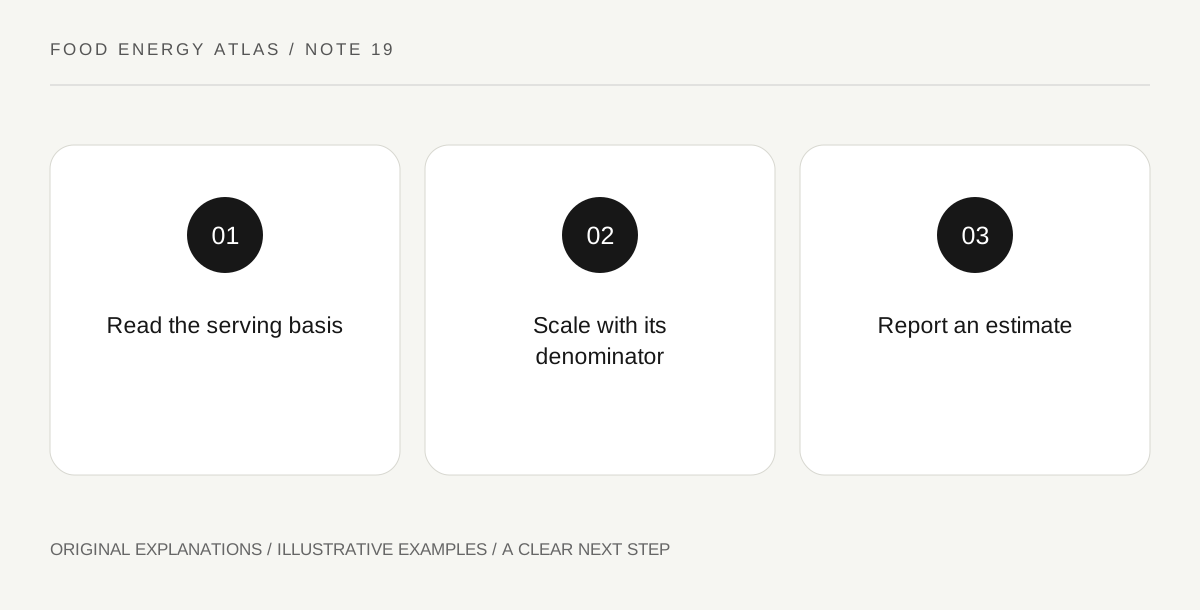
Original explanatory diagram. Read the full method and limitations below.
Find the serving and container amounts
Look for the stated serving size, its metric amount and the number of servings per container. These fields explain what the displayed calories describe. A package can contain more than one serving, and a label serving is not a personal recommendation for how much to eat.
Some labels provide more than one column. Read whether a column refers to one serving, the full package or a prepared version with additional ingredients. Select the basis that corresponds to your calculation. A number detached from its column heading can be applied to the wrong amount even when the multiplication afterward is flawless.
Scale from the label denominator
For a weighed portion, multiply the labelled calories by your grams and divide by the label's serving grams. Do not replace that denominator with 100 unless the label itself gives a per 100g value. If a drink uses a volume serving, scale in the same volume unit or use an appropriate source-backed conversion.
When comparing products, decide whether you want equal-weight concentration or actual-portion energy. Both are legitimate questions when stated clearly. A small labelled serving can make a product's per-serving number look lower than another product's larger serving. Converting to a common basis reveals that difference in the reference amount without judging either food from the calorie field alone.
Do not create precision from display digits
A calculation based on a labelled value is a scaled estimate. A result such as 132.857142 does not establish a food measurement accurate to six decimal places. The input may be rounded, the product varies and the portion measurement has its own limits.
Our tool rounds displayed portion results to one decimal to make the arithmetic readable. That is a display choice, not a claim of laboratory precision. For notes, retain the original label value and serving size so the estimate can be reconstructed. If someone obtains a slightly different final digit, compare rounding and portion assumptions before assuming a meaningful nutritional difference.
Use current product information thoughtfully
A historical generic database record and a current product label serve different purposes. Formulations and reference methods can differ. For a specific packaged food, the actual label is usually the more relevant starting point; generic data remain useful when the exact product is unknown or the question concerns a general food.
Do not treat a small disagreement as proof that a source is fraudulent. Check food identity, serving basis, preparation and date first. If an important product discrepancy remains, ask the manufacturer or an appropriate qualified professional rather than substituting a guessed value. This educational calculator is not a compliance-testing service or a complete analysis of a food's composition.
An illustrative calculation
A fictional package lists 200 kcal per 70g serving. A46.5g portion gives 200×46.5÷70, or approximately 132.9 kcal. Reporting 132.857142 as though it were a direct food measurement would overstate precision. If a second column already gave the entire package value, multiplying that whole-package number by the serving count again would also be incorrect. Always preserve the column heading and serving denominator.
Practical checks
Optional checkboxes save only in this browser.
Questions that come up
Is a label serving my recommended portion?
No. It supplies a reference amount for the label. An appropriate individual portion depends on broader circumstances that this food-scaling tool does not assess.
Should an old generic record override my current package?
For a specific product, use the current matching label unless there is a sound reason to question it. First investigate differences in identity, preparation and serving basis rather than choosing a preferred number.
References and scope
These sources support the factual background. Examples and exercises are original illustrative teaching material. References do not imply endorsement.
- USDA FoodData Central downloadable datasets — The original SR Legacy CSV archive, its final 2018 release and the source of the searchable food records.
- USDA FoodData Central data-type documentation — Differences among historical generic reference data, foundation foods and branded label data.
- FDA: How to understand and use the Nutrition Facts label — Serving amounts, calories, package servings and the distinction between a label serving and an individual recommendation.