Edible Portion and Tare: Leave the Bowl, Peel and Bones Out
A food-composition value refers to the edible material described by its record. A banana weighed with its skin or a fish portion weighed with bones can therefore produce a misleading result. Separate container weight and discarded material before treating a scale reading as edible grams.
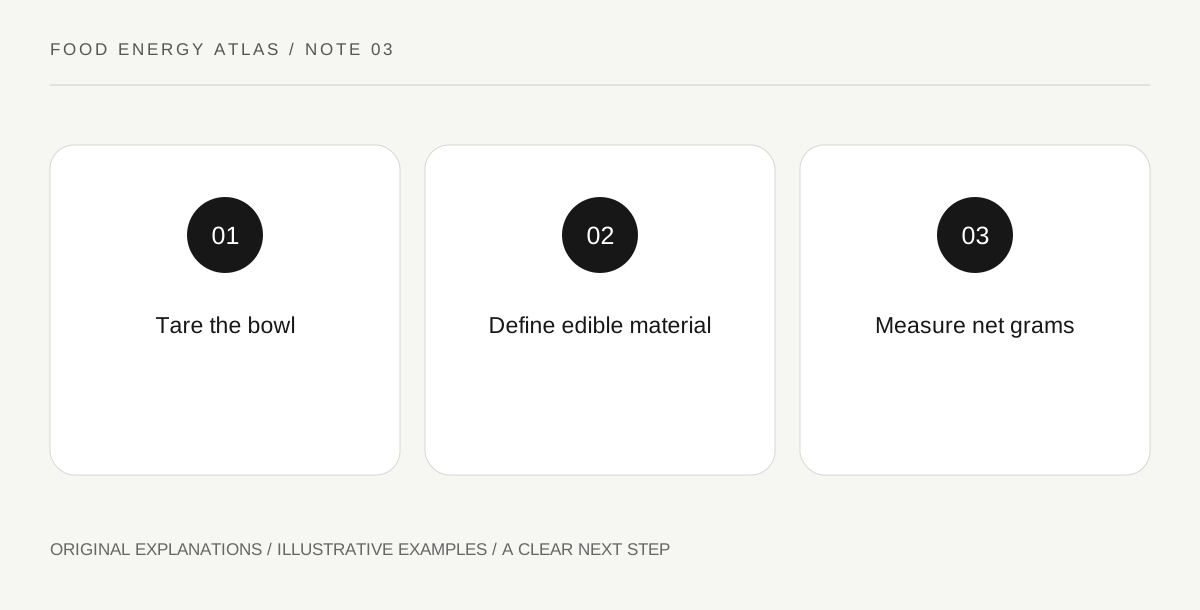
Original explanatory diagram. Read the full method and limitations below.
Begin with the empty container
Put a stable bowl or plate on the scale and use tare to set the displayed weight to zero. Add the food and read the net amount. If you cannot tare, record the empty container and subtract its weight from the combined reading. The bowl belongs in the measuring method, not the food portion.
Check the display unit as well. A scale accidentally left in ounces may give a plausible-looking number that is wrong when entered as grams. Use a flat surface, keep the container within the scale's capacity and wait for a stable reading. A basic unit check is more valuable than repeatedly weighing an incorrectly defined portion.
Define which parts will be eaten
The right edible portion depends on the food and what you actually eat. Some fruit records include skin; others describe peeled material. Meat entries can distinguish lean only from lean and fat. A shell, stone or bone that is discarded should not become part of a food weight whose reference excludes it.
Read the description before deciding what to remove. There is no single rule that all skins count or all skins do not count. Keep the record and preparation aligned, and use an alternative record when the described edible material differs. A photograph of a whole fruit does not establish which parts its nutrient entry includes.
Subtract leftovers with care
Sometimes the easiest estimate starts with a served amount and subtracts what remains. That works best when the remainder is comparable material and has not gained other components. An initially weighed peeled fruit portion minus uneaten peeled fruit is a straightforward mass calculation. A plate of mixed leftovers is harder to interpret.
Bones after eating may retain sauce or food, while their moisture can differ from the original served portion. Subtracting them is a practical approximation rather than an exact laboratory determination. Explain the method instead of implying that every gram of the difference was known edible food. The subtraction cannot resolve uncertainties in the starting reference.
Prefer direct edible measurement
For a food that is easy to peel or debone before weighing, direct edible-weight measurement avoids guessing a universal waste percentage. Whole-fruit weight multiplied by an assumed fraction is convenient, but fruit size, variety and trimming change that fraction. A generic yield assumption should be named as an assumption.
You do not need to dismantle every meal to create a perfect record. Choose a measurement approach that fits the task and acknowledge rough estimates. When preparing a recipe for several people, weighing the edible ingredient before mixing can be more useful than reconstructing every later serving. Save the original ingredient weights with the batch notes.
An illustrative calculation
An illustrative bowl weighs 240g empty and 415g with peeled fruit, so edible fruit weighs 175g. At a hypothetical 64 kcal per 100g, its estimate is 112 kcal. If that fruit had been weighed in a 90g peel, including the discarded peel would add 57.6 kcal to the arithmetic without adding edible fruit. These figures teach the weighing method rather than describe a specific variety or an expected peel percentage.
Practical checks
Optional checkboxes save only in this browser.
Questions that come up
Can I use a package weight?
Only if it describes the edible amount being calculated. A pack may include liquid, bones or other material. Compare any drained-weight statement with the chosen reference and what you actually eat.
Can a cup replace weighing?
A cup is useful when the source supplies an appropriate cup weight. Otherwise packing, chopping and food shape change what fits. Direct weighing removes that conversion step, though it still requires a matching food description.
References and scope
These sources support the factual background. Examples and exercises are original illustrative teaching material. References do not imply endorsement.
- USDA FoodData Central downloadable datasets — The original SR Legacy CSV archive, its final 2018 release and the source of the searchable food records.
- USDA FoodData Central data-type documentation — Differences among historical generic reference data, foundation foods and branded label data.