Raw or Cooked Weight? Make the Scale Agree With the Food Record
Weighing carefully is only useful when the database describes food in the same state. Raw chicken, cooked chicken, dry pasta and drained cooked pasta are different reference objects. A mismatch can overwhelm the benefit of an accurate kitchen scale even when the arithmetic itself is correct.
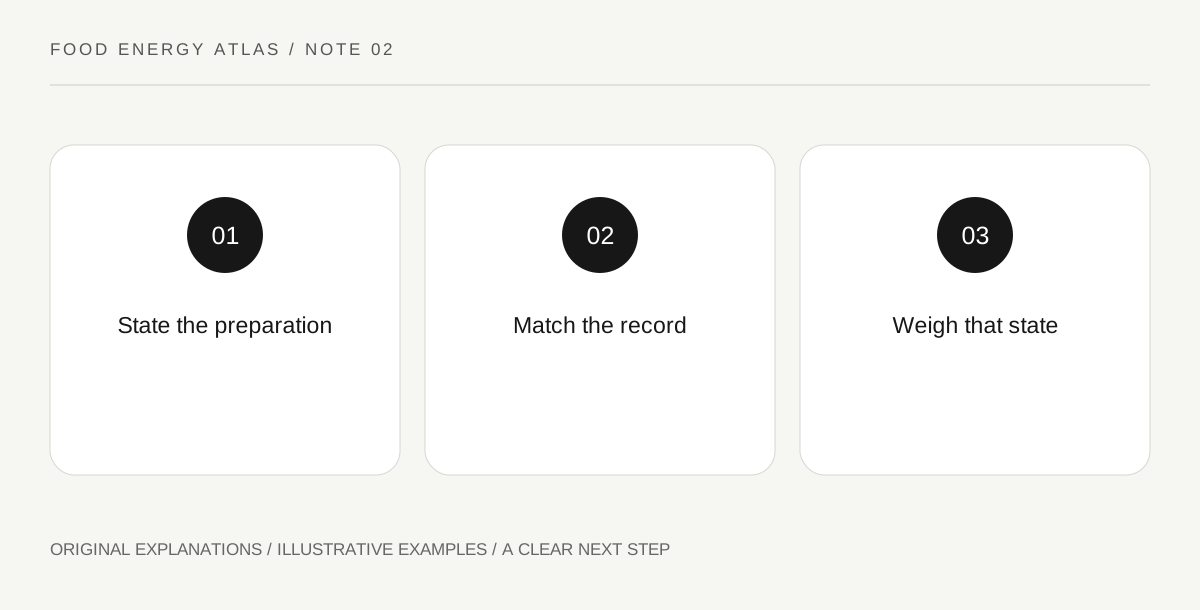
Original explanatory diagram. Read the full method and limitations below.
Name the state before measuring
Decide whether you are recording an ingredient before cooking or the food after cooking. Choose a matching description. Words such as raw, cooked, boiled, roasted, drained and dry are not decorative details. They tell you what material the weight belongs to and may identify a preparation method or added ingredient.
Keep the record's exact wording when saving a calculation. Replacing a long description with just chicken or rice loses the detail needed to understand the result later. A short note such as cooked, drained, no sauce is often more informative than additional digits. Make that choice before entering the weight, rather than selecting a result afterward.
Understand the changing denominator
Cooking can change the amount of water in a food. A dry grain may gain water; meat may lose moisture and release drippings. Consequently, 100g before cooking and 100g afterward need not represent the same starting amount. A change in energy per 100g does not by itself show that energy was created or destroyed.
Do not assume one universal raw-to-cooked multiplier. Cut size, cooking time, equipment, draining and the food itself affect final weight. A measured batch yield tells you about that batch; it should not automatically become a conversion rule for every future meal. Record a new yield when the preparation changes.
Choose one consistent route
For a simple prepared ingredient, weigh the edible cooked food and use a matching cooked reference. For a recipe, you can instead calculate ingredients on their corresponding starting basis and distribute an estimated total across the finished batch. These are different routes to an estimate, each with limits.
Avoid switching halfway through: entering raw ingredient energy and then counting the same ingredient as a cooked component doubles it. Keep an ingredient list with the chosen state beside each weight. Add separate ingredients only once, including additions that actually remain in the finished food. A clear list makes omissions and double counting easier to spot.
Describe what you cannot observe
A kitchen record usually cannot measure exactly how much energy left with discarded cooking liquid, rendered fat or food stuck to a pan. Where a suitable cooked-food entry exists, it may be more appropriate than pretending every raw ingredient remained unchanged. A home recipe estimate still deserves an uncertainty note.
The purpose is a coherent explanation, not a laboratory claim. If two reasonable methods produce different values, compare their assumptions first. Selecting whichever result is smaller conceals the mismatch. A useful note might state that the batch estimate includes all starting ingredients even though some drippings were discarded; readers can then understand that limitation.
An illustrative calculation
Suppose a dry ingredient weighs 100g and has 360 kcal in that starting amount. After adding water, the cooked batch weighs 300g. Ignoring other losses or additions for this arithmetic example, the batch still has an estimated 360 kcal, or 120 kcal per 100g cooked. A150g cooked portion would be 180 kcal. Entering 150g against the dry concentration would wrongly give 540 kcal. These are illustrative values, not a universal cooking yield.
Practical checks
Optional checkboxes save only in this browser.
Questions that come up
Should food always be weighed raw?
No single timing works for every question. Weighing cooked food with a matching cooked reference can be coherent. Matching the state and keeping one calculation route consistent are the important issues.
Does added water add calories?
Plain water does not supply food energy. It changes weight and therefore energy per 100g. Other cooking additions, such as milk or oil, are separate ingredients with their own contribution.
References and scope
These sources support the factual background. Examples and exercises are original illustrative teaching material. References do not imply endorsement.
- USDA FoodData Central downloadable datasets — The original SR Legacy CSV archive, its final 2018 release and the source of the searchable food records.
- USDA FoodData Central data-type documentation — Differences among historical generic reference data, foundation foods and branded label data.