Cereal and Granola Calories: The Bowl Does Not Define the Serving
A full bowl of cereal is a visual description, not a standardized weight. Flakes, dense granola and puffed products occupy space differently, and milk or toppings add separate ingredients. Read the package reference and measure the portion you want to understand before comparing breakfast bowls.
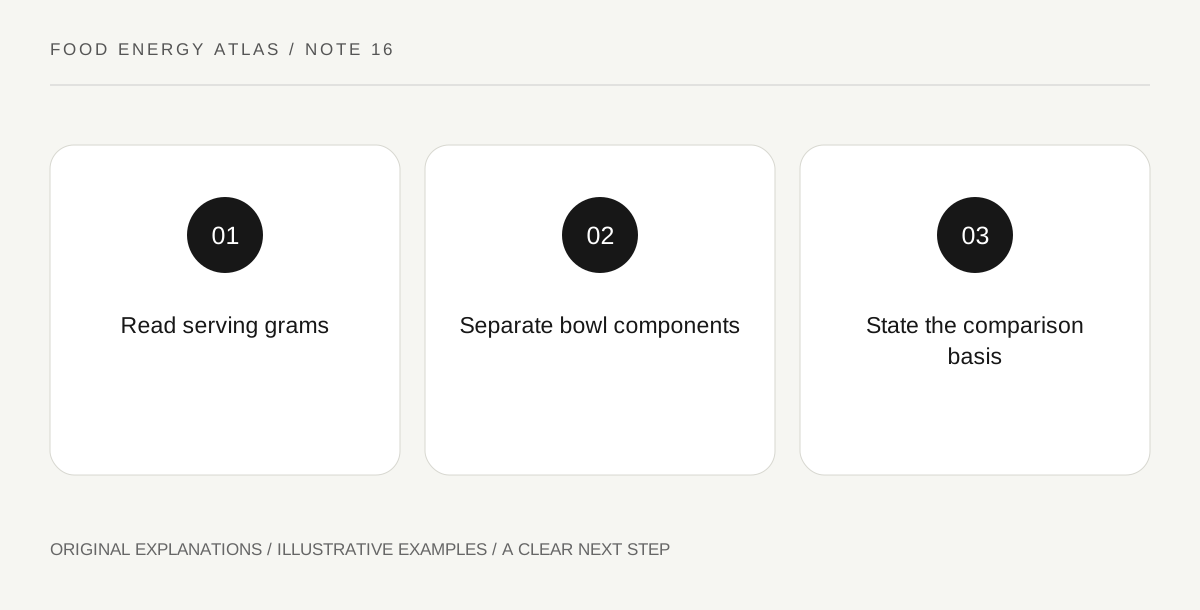
Original explanatory diagram. Read the full method and limitations below.
Read the product rather than the category
Cereal includes many formulations, from plain grains to sweetened mixtures with nuts or dried fruit. Granola has its own ingredient proportions. A generic search result may help describe an unfamiliar food, but the current label for the exact product is usually more specific for a packaged cereal.
Read the serving quantity and its gram equivalent together. A cup measure describes volume, and a gram amount describes mass. Two cereals can have different gram weights in the same cup. Comparing their calories per cup therefore answers a different question from comparing calories per 100g. Keep the basis explicit instead of treating either comparison as universally correct.
Weigh the cereal before adding liquids
Tare the empty bowl, add cereal and record its weight before milk or yoghurt goes in. This separates the dry product from additions and avoids trying to reconstruct it after everything is mixed. If using a label's serving amount without a scale, recognize that a casually filled bowl may contain more or less than that serving.
Crushed pieces, settling and how a measuring cup is filled can change a volume measurement. A large bowl with a shallow layer can also look less full than a small bowl containing the same weight. Visual fullness is useful for serving but does not establish a universal conversion to grams.
Account for milk, yoghurt and toppings
Use the relevant product and amount for milk or yoghurt. Nuts, fruit, honey and other toppings each have their own reference. Do not assume the cereal label includes them unless it explicitly describes a prepared serving with those additions.
If a label offers separate columns for dry cereal and cereal with milk, select the column that matches your method. Counting the prepared column and then adding the same milk again doubles it. Conversely, a dry-cereal figure alone does not describe the whole breakfast. Write the components on separate lines so changing one amount does not obscure the rest of the calculation.
Use the result for the question it answers
A breakfast with a higher estimated energy amount is not automatically less suitable, and a smaller number does not assess whether the meal is satisfying or nutritionally adequate. This reference scales foods; it does not rank breakfasts or prescribe a portion size.
For a comparison experiment, keep one variable fixed. You might compare equal weights of two cereals, or compare two actual bowls prepared the way you enjoy them. Those are both legitimate questions when named clearly. Avoid switching between equal-volume and equal-weight comparisons mid-conclusion, because doing so can make an apparent difference reflect the serving definition rather than the product alone.
An illustrative calculation
An invented cereal label lists 160 kcal per 40g. A55g cereal portion gives 220 kcal. If the measured milk addition contributes 75 kcal and fruit contributes 30 kcal, the bowl total is 325 kcal. The cereal's dry figure did not include those additions. These figures teach component calculation and are not a recommended breakfast size or a measured value for any cereal brand.
Practical checks
Optional checkboxes save only in this browser.
Questions that come up
Is granola always the same as another cereal by volume?
No. Ingredient density and piece size affect how many grams fit in a cup. Use the exact label or measured weight instead of assigning one cup weight to every product.
Does this recommend a cereal serving size?
No. A label serving is a reference amount, and the calculator scales it or a database value. It does not establish an appropriate breakfast portion for an individual.
References and scope
These sources support the factual background. Examples and exercises are original illustrative teaching material. References do not imply endorsement.
- USDA FoodData Central downloadable datasets — The original SR Legacy CSV archive, its final 2018 release and the source of the searchable food records.
- USDA FoodData Central data-type documentation — Differences among historical generic reference data, foundation foods and branded label data.
- FDA: How to understand and use the Nutrition Facts label — Serving amounts, calories, package servings and the distinction between a label serving and an individual recommendation.