Cheese Calories: Compare the Cheese Type and the Portion You Use
A cheese slice, a spoonful of soft cheese and a handful of grated cheese are different portion descriptions. Cheese type and moisture also vary. Start with a matching product or reference, then weigh the edible amount rather than transferring one per-piece figure across unrelated cheeses.
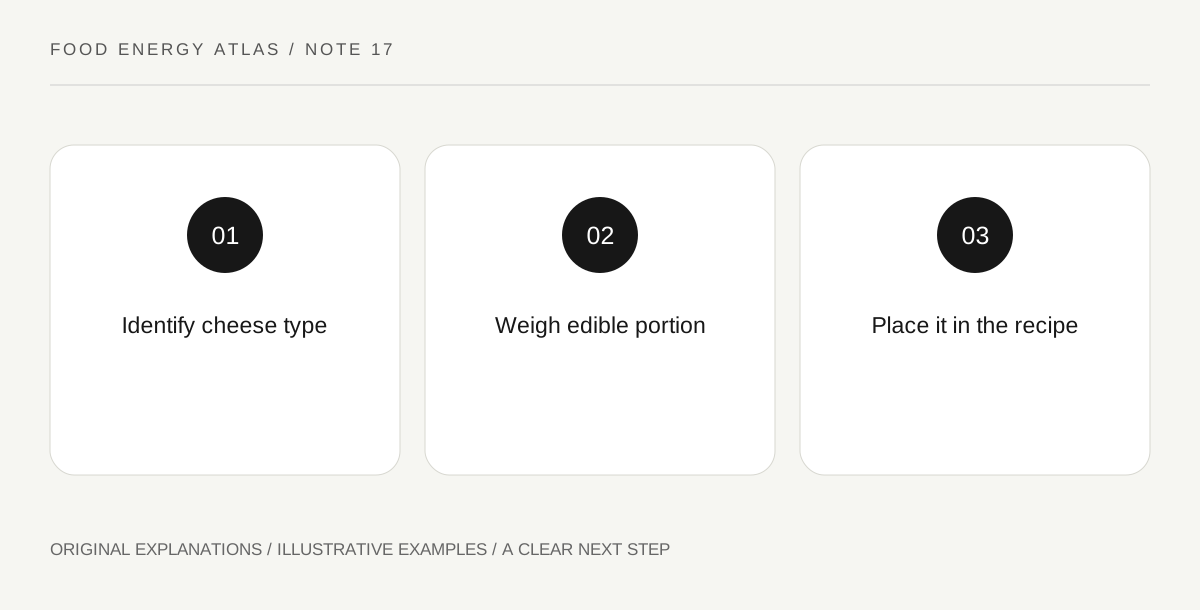
Original explanatory diagram. Read the full method and limitations below.
Identify the cheese or prepared product
Fresh, soft, semi-hard, hard, reduced-fat and processed cheese products can have different compositions. Read the full name, not just the word cheese. A current label is useful for a specific packaged product, especially a spread, slice or blend with a defined formulation.
Generic reference data can still help when a label is unavailable. Select the closest description and record that substitution. Similar uses in cooking do not establish identical energy concentrations. A cheese used in a sandwich and a soft cheese stirred into a sauce may serve related purposes while remaining different reference foods. Keep their ingredient identities separate in a recipe.
Make slices and grated portions measurable
A per-slice label applies to its stated slice size. A thick hand-cut slice from a block may weigh more than the packaged reference. If weighing, tare a plate and measure the edible portion. If using a labelled slice count, retain the corresponding gram definition so the estimate can be understood later.
Grated cheese is especially difficult to measure consistently by a casual handful or loosely filled cup. Shred size and compression change the amount that fits. A source-provided household measure can be used within its stated context, but it is not a universal weight for every cheese, grater or measuring method.
Keep rind and discarded material consistent
Some cheese portions include an edible rind and others are trimmed. The reference and weight should describe the material actually eaten. Do not weigh a substantial discarded rind against an edible cheese concentration and assume the whole reading represents the portion consumed.
For a grated or cubed ingredient, weighing after trimming can simplify the method. A recipe that starts with a block weight but discards material should note that distinction. Small kitchen estimates do not need laboratory-level reconstruction, but the approach should be coherent enough that a reader can tell which material entered the calculation and which remained outside the dish.
Separate cheese from the dish around it
A cheese sauce, pizza topping or baked dish includes other ingredients. If using a known recipe, calculate the cheese contribution from its actual amount and combine it with the other components. If using a prepared-product label, avoid adding ingredients already counted in that product.
Melting or spreading changes appearance and distribution, not a known universal share of calories. Cheese left in a pan or on a serving utensil introduces practical uncertainty. Weight-based division of a mixed dish assumes the portion represents its ingredients. A heavily topped corner and a lightly topped corner may not have the same composition even if they weigh alike.
An illustrative calculation
Suppose an illustrative cheese reference gives 350 kcal per 100g. A24g edible portion gives 84 kcal. If a recipe uses 96g of that cheese across four evenly distributed servings, the estimated cheese contribution is also 84 kcal per serving. The rest of the dish still needs its own calculation. These invented values do not describe every cheese slice, grated handful or product labelled with a similar name.
Practical checks
Optional checkboxes save only in this browser.
Questions that come up
Can I use one grated-cup weight for all cheese?
No. Shred size, packing and product characteristics vary. A matching source-provided measure is an estimate within that context; direct weighing removes the cup-to-gram assumption.
Does melted cheese have fewer calories because it looks smaller?
Appearance alone does not establish an energy change. Use the amount of cheese included and account for substantial discarded material or other ingredients rather than estimating from its melted volume.
References and scope
These sources support the factual background. Examples and exercises are original illustrative teaching material. References do not imply endorsement.
- USDA FoodData Central downloadable datasets — The original SR Legacy CSV archive, its final 2018 release and the source of the searchable food records.
- USDA FoodData Central data-type documentation — Differences among historical generic reference data, foundation foods and branded label data.