Cooking Oil Calories: Measure Small Amounts Without Inventing Absorption
Small ingredient weights can make a noticeable difference to an energy estimate, and cooking oil is a common example. The challenge is not complicated multiplication. It is defining whether the measured amount was added, remained in the dish or was discarded, and keeping those quantities distinct.
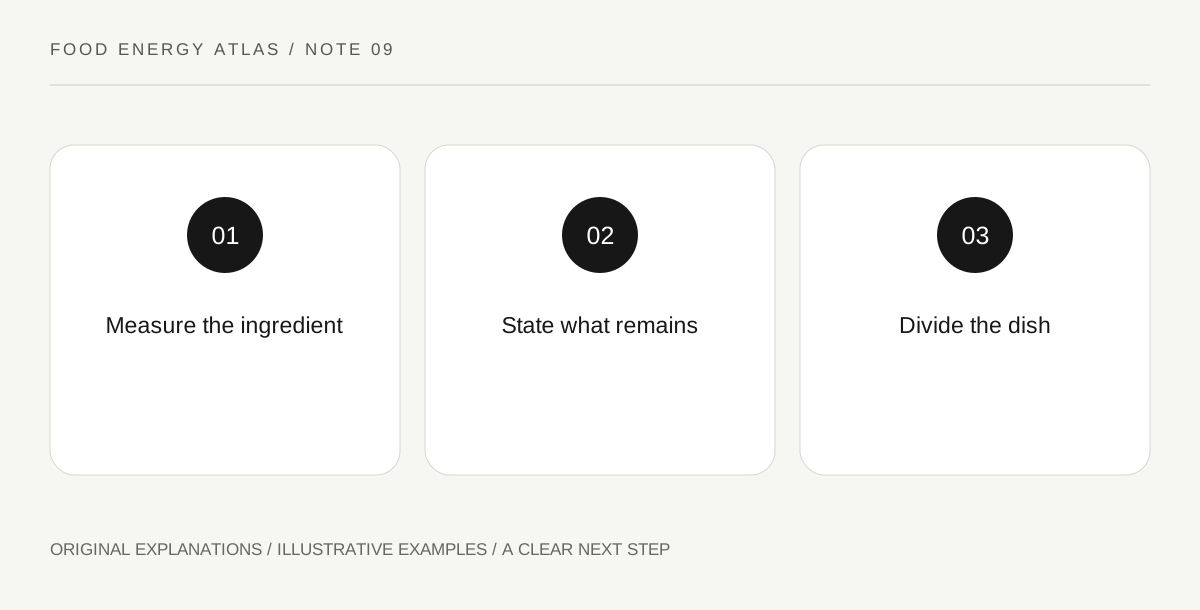
Original explanatory diagram. Read the full method and limitations below.
Choose weight or a matched label measure
If your reference is per 100g, oil weighed in grams can be scaled directly. If the product label gives a volume serving, scale within that labelled volume unit or use the product's specified gram equivalent. Do not assume a millilitre of every ingredient has the same mass as a gram.
A kitchen spoon and a standardized measuring spoon are not necessarily the same volume. A casual drizzle is less defined still. For a recipe you want to reproduce, weighing the oil or using a suitable marked measure creates a clearer ingredient record. The chosen method matters more than displaying many decimal places in the final result.
Use the scale within its practical limits
A very small oil addition may be close to a kitchen scale's display increment. Repeatedly adding and removing tiny amounts can produce unstable readings that appear exact but are not. Use the scale according to its instructions and avoid interpreting a zero display as proof that no ingredient was added.
One practical ingredient method is weighing a container before and after dispensing, provided the difference is large enough for that scale to resolve and the container remains clean and stable. Record the difference as oil dispensed. That measurement does not by itself establish how much later remained in the cooked portion.
Separate added oil from oil eaten
Oil can remain in a pan, on utensils or in uneaten dressing. A record of oil added to the recipe is therefore an ingredient estimate, not a direct measurement of absorption. Conversely, simply ignoring all oil because some remains behind creates another unsupported assumption.
For a home recipe, state whether the estimate includes the full added amount. If losses are substantial and unknown, explain that limitation rather than subtracting a universal absorption percentage. For a commercially prepared fried food, a matching product label or prepared-food reference is usually more relevant than reconstructing its recipe from a guessed spoonful of oil.
Distribute oil within the actual dish
Oil may be distributed unevenly across a salad or roasting tray. A portion scooped from a pool of dressing can differ from a portion taken from a drier area. Weight-based batch division assumes a representative share of the ingredients, not merely a certain number of grams on the plate.
Mixing a dressing before dividing it, or measuring a portion separately when that is practical, can make the estimate easier to understand. Keep this as a method for a particular question rather than a demand to measure every meal. Energy arithmetic does not establish an appropriate personal intake or make cooking enjoyment dependent on perfect measurement.
An illustrative calculation
Suppose a fictional reference oil provides 880 kcal per 100g. A measured 8g addition gives 70.4 kcal. If that amount is evenly included in a dish divided into four equal shares, each share receives an estimated 17.6 kcal from the oil. The example assumes all 8g remain in the dish. It cannot tell you how much was absorbed during an actual cooking process or justify subtracting an invented loss percentage.
Practical checks
Optional checkboxes save only in this browser.
Questions that come up
Can I treat a spray as calorie-free?
Read the current label and its serving amount. A tiny labelled serving can be very different from the amount used across a pan. This calculator cannot measure spray duration or translate it into grams without a source-backed amount.
Does oil type change the weighing method?
The same proportional method works with a matching reference, but do not use one product label as a precise composition measurement for every other oil. Keep the food identity and reference amount visible.
References and scope
These sources support the factual background. Examples and exercises are original illustrative teaching material. References do not imply endorsement.
- USDA FoodData Central downloadable datasets — The original SR Legacy CSV archive, its final 2018 release and the source of the searchable food records.
- USDA FoodData Central data-type documentation — Differences among historical generic reference data, foundation foods and branded label data.