Recipe Calories by Batch Weight: A Calculation You Can Reconstruct
A recipe estimate becomes easier to understand when ingredients, final batch weight and portion weight are recorded separately. This method can describe a homemade dish with known ingredients, provided its assumptions remain visible. It cannot turn uncertain ingredient data or uneven servings into an exact laboratory result.
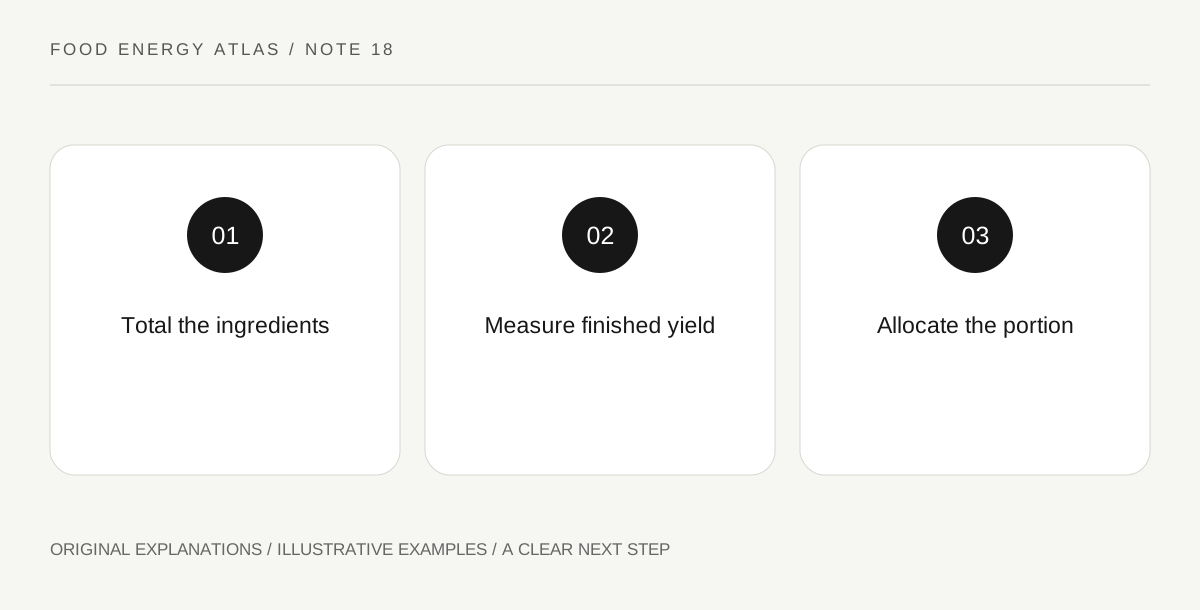
Original explanatory diagram. Read the full method and limitations below.
Build an ingredient ledger
List each ingredient, its edible amount, the food reference used and the calculation for that amount. Match raw, dry or prepared states to the chosen records. Include additions once. A sauce entered as a complete product should not also be broken into the same ingredients unless you replace the complete-product line.
Keep units consistent and preserve the source reference amount. A per 100g ingredient uses grams divided by 100; a package serving uses its own stated denominator. The ledger lets another person reproduce the arithmetic and spot missing ingredients without guessing which number represents a whole batch, a single serving or a concentration.
Weigh the finished edible batch
Use the final food weight after the preparation stage relevant to serving, excluding the pot or dish. Tare the container when practical or subtract its measured empty weight. Record whether liquid is included and whether any substantial ingredient material was discarded.
The batch total from starting ingredients may overstate what remains when energy-containing drippings or other material are discarded. Conversely, later additions can make it incomplete. State those limits rather than treating final weight as a composition measurement. Weighing yield provides a denominator for portioning; it does not directly measure all nutritional changes caused by preparation.
Calculate a representative portion
Divide the estimated batch calories by finished edible batch grams to obtain estimated kcal per gram. Multiply by the portion grams. Alternatively, multiply the batch total by the portion's fraction of the batch weight. The two routes should agree when the same values and assumptions are used.
This requires a reasonably representative mixture. A stew ladle mostly containing liquid is not compositionally identical to another ladle full of solids. Stirring before portioning or serving components separately can improve the estimate. If ingredients are unevenly distributed, note that weight-based allocation is approximate rather than hiding that issue behind a precise decimal result.
Preserve the record for leftovers
Keep the batch calculation and initial portion allocation together. Reheating can change water content and weight, so a later lighter portion is not automatically a smaller share of the original ingredients. Record new ingredients added during reheating separately.
If you deliberately divide the original batch into equal representative containers, you can preserve each container's original estimated share. Do not repeatedly invent a new batch total from changing water weight. When recipes change materially, update the ingredient ledger and measured yield rather than assuming the previous batch's per 100g figure remains exact. The method is useful because its assumptions are inspectable, not because homemade food is perfectly uniform.
An illustrative calculation
Imagine a complete ingredient ledger totals 1,440 kcal and the finished edible batch weighs 1,200g. The estimate is 1.2 kcal per gram, or 120 kcal per 100g. A250g representative portion gives 300 kcal. Six equal portions of 200g would each give 240 kcal. The example assumes all counted energy remains and the mixture is even; it does not account for unmeasured discards or unequal ingredient distribution.
Practical checks
Optional checkboxes save only in this browser.
Questions that come up
Can I just divide by the number of servings?
Yes, if that is a meaningful description of how the dish is divided. Equal-looking servings may differ, so retain the allocation assumption. Weight-based division is another method, not a guarantee of identical composition.
Does the final batch weight reveal calories directly?
No. It is a portioning denominator. The energy estimate comes from ingredient or prepared-food data and assumptions about what remains in the finished dish.
References and scope
These sources support the factual background. Examples and exercises are original illustrative teaching material. References do not imply endorsement.
- USDA FoodData Central downloadable datasets — The original SR Legacy CSV archive, its final 2018 release and the source of the searchable food records.
- USDA FoodData Central data-type documentation — Differences among historical generic reference data, foundation foods and branded label data.