Restaurant Calories: Use Available Information and Name What Is Unknown
A restaurant meal can be difficult to reconstruct because ingredient quantities and preparation are hidden. Published menu information can help, but it belongs to a specified item and configuration. Use it within that scope and keep a rough component estimate visibly different from an analysis of the kitchen's actual recipe.
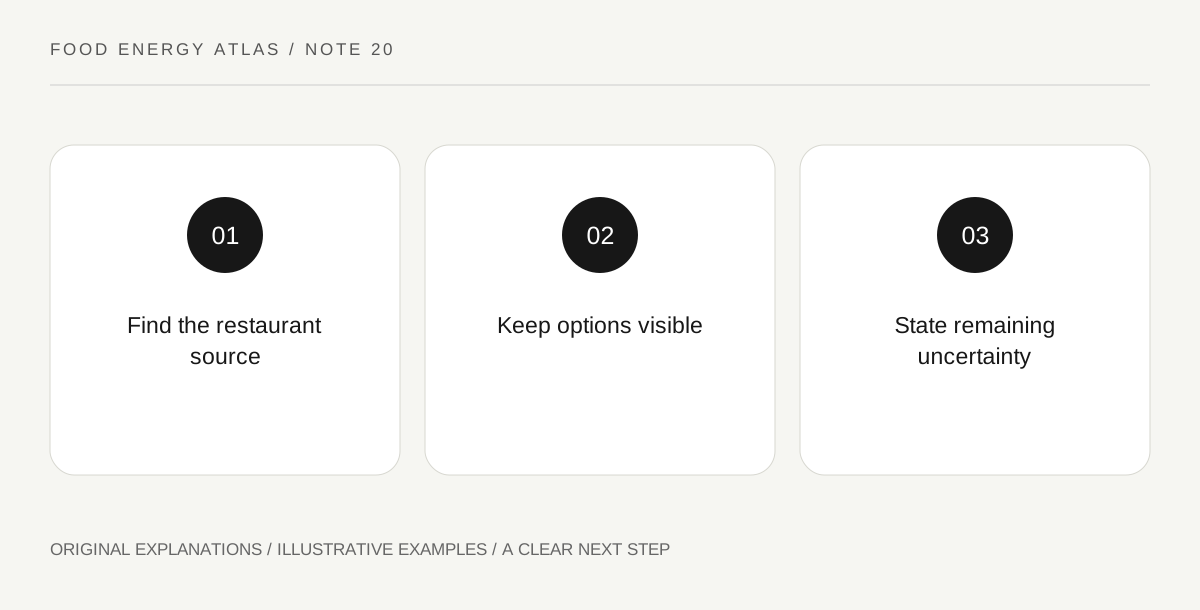
Original explanatory diagram. Read the full method and limitations below.
Start with the restaurant source
Look for the establishment's current menu or nutrition information for the exact item, size and market. A similar name from another restaurant is not automatically the same recipe. Save the configuration being described, including meaningful choices of sides, toppings or drink size.
In the United States, federal menu-labeling requirements cover certain chain establishments, rather than every restaurant. Covered businesses provide calorie information for standard items and additional written nutrition information on request. Check the FDA source for the rule's scope. The absence of a calorie number at a small independent venue does not by itself establish that the business has failed to follow that federal requirement.
Keep modifications visible
A menu figure may describe a standard preparation. Extra cheese, a different dressing or a substituted side can alter the dish. Use the business's own option information where available. Do not subtract an invented allowance for every removed ingredient or assume that a menu photograph reveals exact quantities.
If modifications cannot be quantified, label the result as approximate. A clear note such as standard menu item, side changed, dressing amount unknown is more informative than a precise-looking reconstructed total. The goal is to understand the available evidence, not to claim access to a recipe or a measured serving that you have not observed.
Use component estimates as estimates
When no useful menu information exists, a component approach can identify what is known and unknown: plain grain, cooked protein, vegetables, sauce and other additions. Select relevant references and plausible measured amounts only where there is a basis for them. Appearance alone cannot reveal the mass or formulation of every component.
Avoid presenting a guessed dish weight as a measurement. If using a scenario, state that the quantities are hypothetical. An interval based on explicit alternative assumptions may be more honest than one exact number, but it is still not a verified confidence interval or a laboratory result. The unknown recipe remains unknown after the arithmetic is completed.
Keep the meal in a broader context
A calorie estimate cannot establish allergy safety, nutritional adequacy or whether a meal suits a medical condition. Restaurant staff, product information and individualized professional guidance may be needed for those questions. A lower estimated energy number does not automatically identify the most suitable choice for every diner.
Nor does every meal require a detailed reconstruction. This reference is available for people who find the explanation useful, not as a requirement to track social meals. If the available information is too incomplete, saying that the estimate is uncertain is an acceptable outcome. More decimal places or additional unrelated searches do not resolve missing ingredient quantities.
An illustrative calculation
Suppose a fictional standard menu item is listed at 650 kcal. A separately documented side substitution adds an estimated 80 kcal relative to the standard configuration, giving 730 kcal under that stated assumption. If dressing quantity is unknown, the estimate still has that limitation. The calculation does not establish a universal value for the dish name or measure what every branch serves; it simply explains how the available figures were combined.
Practical checks
Optional checkboxes save only in this browser.
Questions that come up
Can another restaurant with the same dish name supply the number?
It can offer a rough comparison, but not an exact measurement of this restaurant's recipe. Ingredients, portions and preparation can differ substantially despite a shared dish name.
Does the federal US rule apply to every café?
No. It has a defined scope covering certain chain establishments and standard menu items. Read the FDA reference for the current criteria rather than assuming that every independent business must display identical information.
References and scope
These sources support the factual background. Examples and exercises are original illustrative teaching material. References do not imply endorsement.
- USDA FoodData Central downloadable datasets — The original SR Legacy CSV archive, its final 2018 release and the source of the searchable food records.
- USDA FoodData Central data-type documentation — Differences among historical generic reference data, foundation foods and branded label data.
- FDA: Menu labeling requirements — The scope of US chain-restaurant menu calorie information and additional written nutrition information.